
When Does a Core Investment Company Need RBI Registration?
A practical guide to the CIC structure, RBI's 90/60 tests, public funds and the principal-business question
A Core Investment Company, or CIC, does not need RBI registration merely because it holds shares in group companies. The current RBI framework requires a combined analysis: does the company fit the CIC structure, what is its asset size, and does it raise or hold public funds? A CIC with assets of at least ₹100 crore that raises or holds public funds requires a Certificate of Registration. Other CICs described in paragraph 16 of the RBI Directions are treated as unregistered CICs.
Key Takeaways
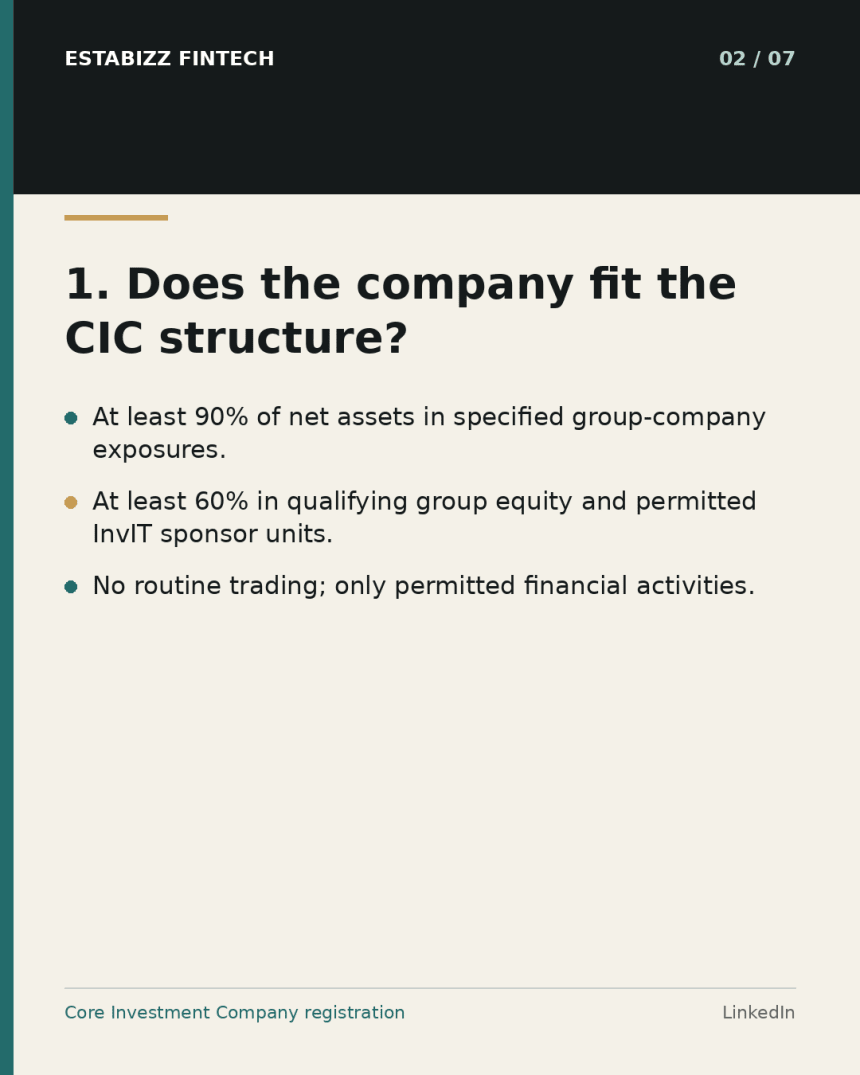
CIC classification begins with the RBI's structural conditions: at least 90% of net assets in specified group-company exposures and at least 60% of net assets in qualifying group equity and permitted InvIT sponsor units.
The company must generally avoid trading those group exposures and may conduct only the financial activities expressly permitted by the CIC Directions.
The registration trigger is not the 90/60 test alone. Asset size and public funds are decisive: a CIC with assets of ₹100 crore or more that accesses public funds must register.
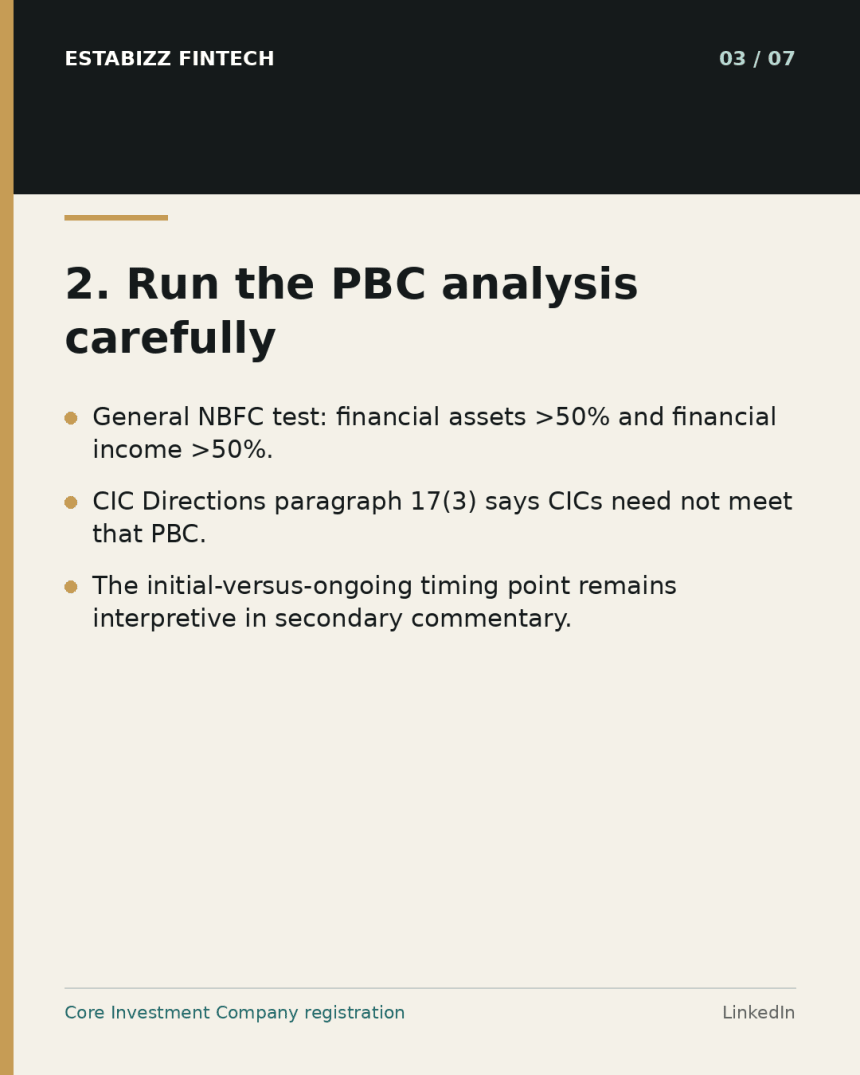
Paragraph 17(3) says CICs need not meet the general NBFC principal-business criteria. The text does not expressly settle every timing and classification question raised by holding-company structures, so borderline cases require a documented professional view and, where necessary, RBI engagement.
Classification should be tested from the latest audited balance sheet and revisited when funding, group structure or activities change.
Why the CIC Question Is Easy to Misread
A group holding company may look like a financial company because most of its balance sheet consists of shares, loans or guarantees involving group entities. That does not make every holding company a registered CIC. The RBI Directions use a defined structure and then apply a separate registration test. Treating one threshold as the whole answer can produce the wrong conclusion.
The confusion is sharpened by the general NBFC principal-business criteria, commonly called the 50/50 test. Under paragraph 38 of the RBI's Registration, Exemptions and Scale Based Regulation Directions, financial assets must be more than 50% of total assets, net of intangible assets, and income from those financial assets must be more than 50% of gross income. Both limbs are ordinarily required to identify an NBFC.
What Qualifies as a Core Investment Company
Paragraph 3 of the Core Investment Companies Directions, 2025 describes a CIC as an NBFC carrying on the business of acquiring shares and securities and meeting the following conditions at the date of the latest audited balance sheet.
Test | Current RBI requirement | Practical review point |
|---|---|---|
90% group exposure | At least 90% of net assets in equity, preference shares, bonds, debentures, debt or loans in group companies. | Map every balance-sheet exposure to the RBI definition of a group company and the net-assets calculation. |
60% equity concentration | At least 60% of net assets in group-company equity, eligible compulsorily convertible instruments and permitted InvIT sponsor units. | Check instrument terms, conversion period and whether the investee is genuinely within the defined group. |
No routine trading | Group investments are not traded except through block sales for dilution or disinvestment. | Review transaction frequency, treasury intent and board records; a trading pattern may contradict CIC character. |
Restricted financial activity | Only specified liquidity investments, group-company loans and guarantees for group companies are permitted financial activities. | Identify any lending, investment or financial service outside the permitted perimeter. |
For this purpose, net assets exclude cash and bank balances, specified money-market holdings, advance tax and deferred tax payments. The calculation therefore needs an audited schedule rather than a quick percentage of total assets.
The Registration Test Is Separate
Once a company fits the CIC structure, paragraph 16 draws the registration boundary. A CIC with assets below ₹100 crore is an unregistered CIC whether or not it accesses public funds. A CIC with assets of ₹100 crore or more that does not access public funds is also an unregistered CIC. A CIC at or above ₹100 crore that raises or holds public funds must register with RBI.
Asset size and funding | RBI position | Immediate action |
|---|---|---|
Below ₹100 crore | Unregistered CIC, regardless of public funds, under paragraph 16(a). | Continue to verify CIC conditions and monitor the audited asset threshold. |
₹100 crore or more; no public funds | Unregistered CIC under paragraph 16(b). | Document the absence of public funds and reassess before borrowing or issuing guarantees that may require funding. |
₹100 crore or more; raises or holds public funds | Registration required; a CoR should be obtained before accessing public funds. | Prepare the PRAVAAH application and supporting audited classification and funding evidence. |
Public Funds Is Broader Than Public Deposits
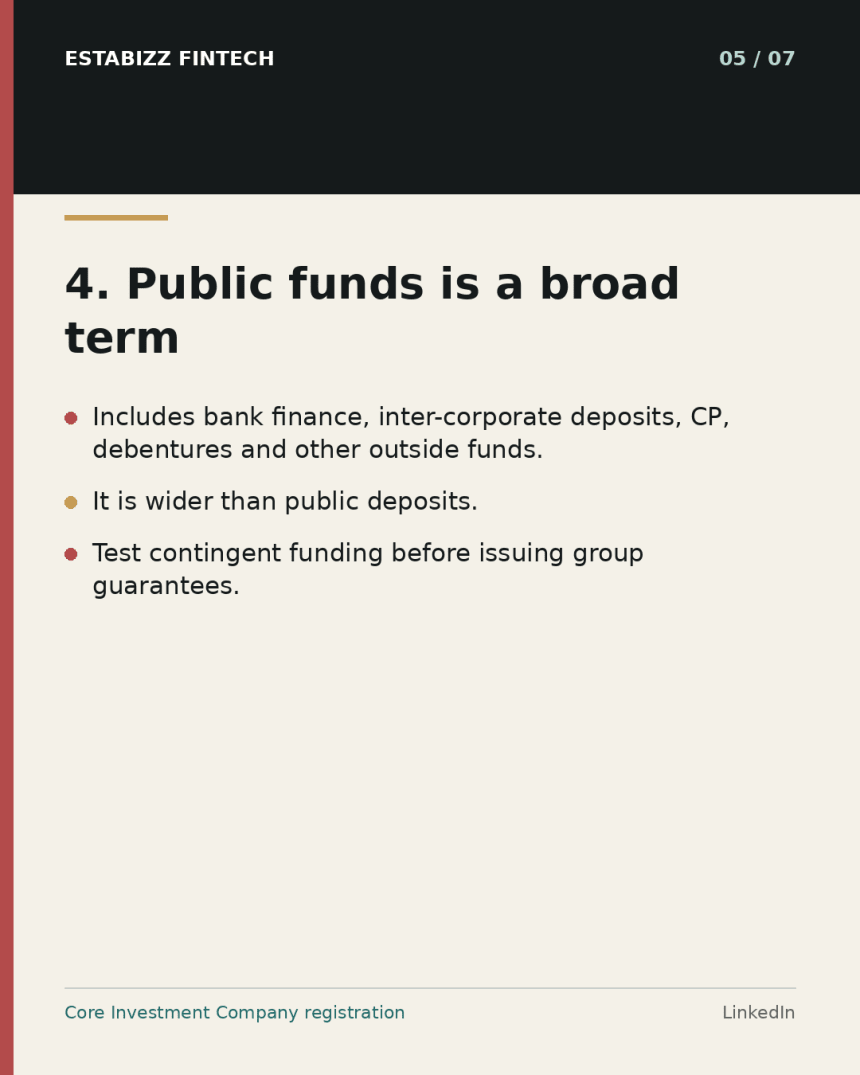
The CIC Directions define public funds broadly. They include public deposits, inter-corporate deposits, bank finance, commercial paper, debentures and other funds received from outside sources. Instruments compulsorily convertible into equity within a period not exceeding ten years are excluded from that definition. A company should not assume that private group borrowing or a bank facility is outside the test simply because it is not a retail deposit.
Guarantees also require care. An unregistered CIC must be able to meet a devolved guarantee without recourse to public funds. If performance would require outside funding, paragraph 16 indicates that the company should approach RBI for registration before accessing those funds.
How the Principal Business Paradox Arises
The general 50/50 test focuses on both financial assets and financial income. A strategic holding company may readily satisfy the asset limb but receive little dividend income in a particular year. It may earn operating or brand income instead. This creates the apparent paradox: the company may satisfy the CIC 90/60 asset structure while failing the income limb ordinarily used to identify an NBFC.
A Practical Classification Workflow
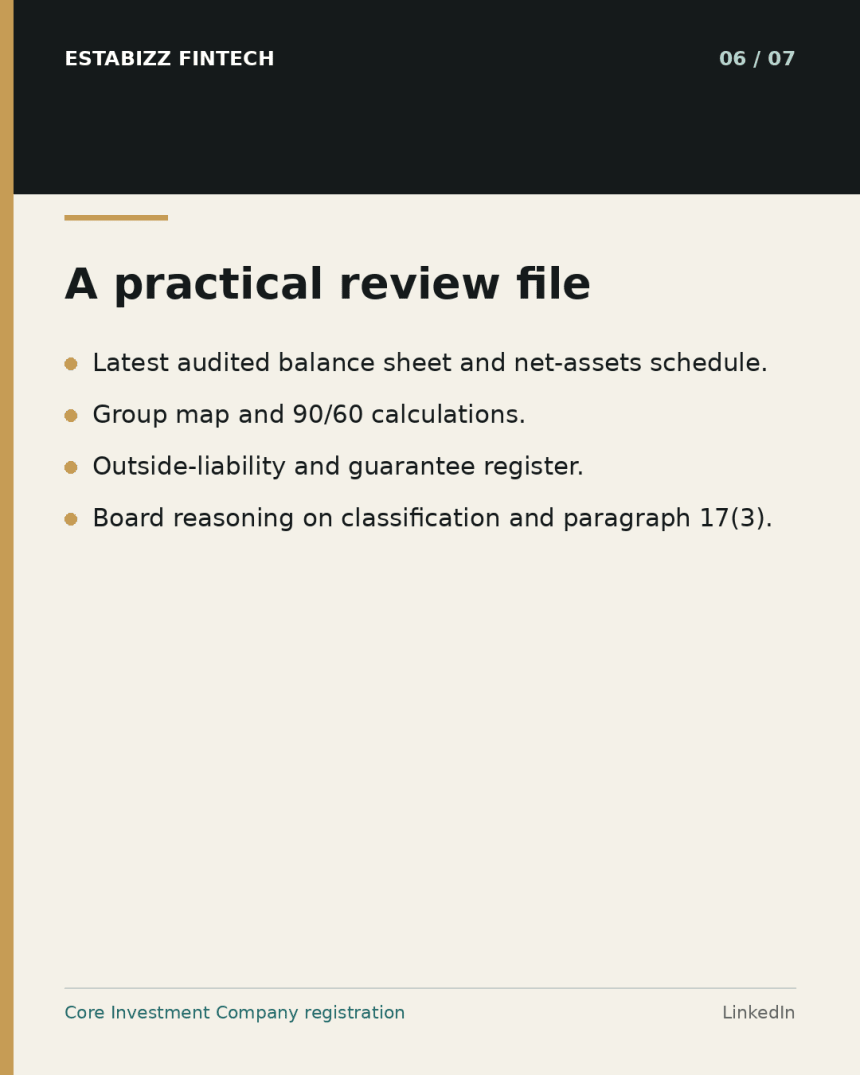
1. Start with the latest audited balance sheet. Prepare a line-by-line schedule of total assets, net assets, financial assets and financial income.
2. Map the group. Test each relationship against the RBI definition and document why the entity is a group company.
3. Run the CIC 90/60 calculations. Separately identify non-group assets, permitted liquidity holdings and fixed assets needed for effective functioning.
4. Review activities, not only balances. Look for trading, non-group lending, financial services, guarantees and transactions that may create an impermissible financial asset.
5. Measure asset size individually and, where relevant, with other CICs in the group. Do not ignore the aggregation language in the Directions.
6. Trace every outside liability and contingent funding source. Test bank finance, inter-corporate deposits, debt instruments and guarantee support against the public-funds definition.
7. Record the principal-business analysis and the paragraph 17(3) position. If the answer depends on the timing of the PBC exemption, obtain a specific legal and regulatory opinion and consider RBI clarification before acting.
8. Recheck before a funding event, restructuring, acquisition, dividend change or new financial activity. These events can alter the classification or registration outcome.
Common Mistakes to Avoid
Calling every group holding company a CIC without applying the RBI's defined group, net-assets and activity tests.
Treating ₹100 crore as a standalone registration trigger while ignoring public funds.
Reading public funds as public deposits only.
Using total assets in place of net assets for the 90/60 calculations.
Assuming paragraph 17(3) automatically resolves every initial-classification question without documenting the reasoning.
Relying on an unaudited management balance sheet when the Directions point to the latest audited balance sheet.
Frequently Asked Questions
Is every holding company a CIC?
No. The company must satisfy the CIC structure in paragraph 3, including the 90/60 concentration tests, restrictions on trading and the permitted-activity perimeter. A holding-company label by itself is not enough.
Does a CIC always need RBI registration?
No. Paragraph 16 recognises unregistered CICs. Registration is required when the company is a CIC, has assets of at least ₹100 crore and raises or holds public funds.
What counts as public funds for a CIC?
The definition includes bank finance, inter-corporate deposits, commercial paper, debentures, public deposits and other outside funds. It is broader than money collected from retail depositors.
Does a CIC have to pass the NBFC 50/50 test?
Paragraph 17(3) says CICs need not meet the general principal-business criteria. However, the way that relief interacts with initial classification has generated interpretive debate. Borderline structures should be reviewed on their facts rather than resolved by a slogan.
Can an unregistered CIC issue a guarantee for a group company?
The Directions contemplate guarantees, but the CIC must be able to honour a devolved liability without recourse to public funds. Otherwise it should approach RBI for registration before accessing those funds.
How quickly must a registrable CIC apply?
Paragraph 15 states that a CIC should apply through PRAVAAH within three months of becoming a CIC. Planning should begin earlier because the classification, audited schedules and funding evidence need to be coherent.
Should the test be repeated every year?
Yes. The Directions use the latest audited balance sheet, and funding or activity changes can change the result. A documented annual review and event-driven review are prudent.
Final Perspective
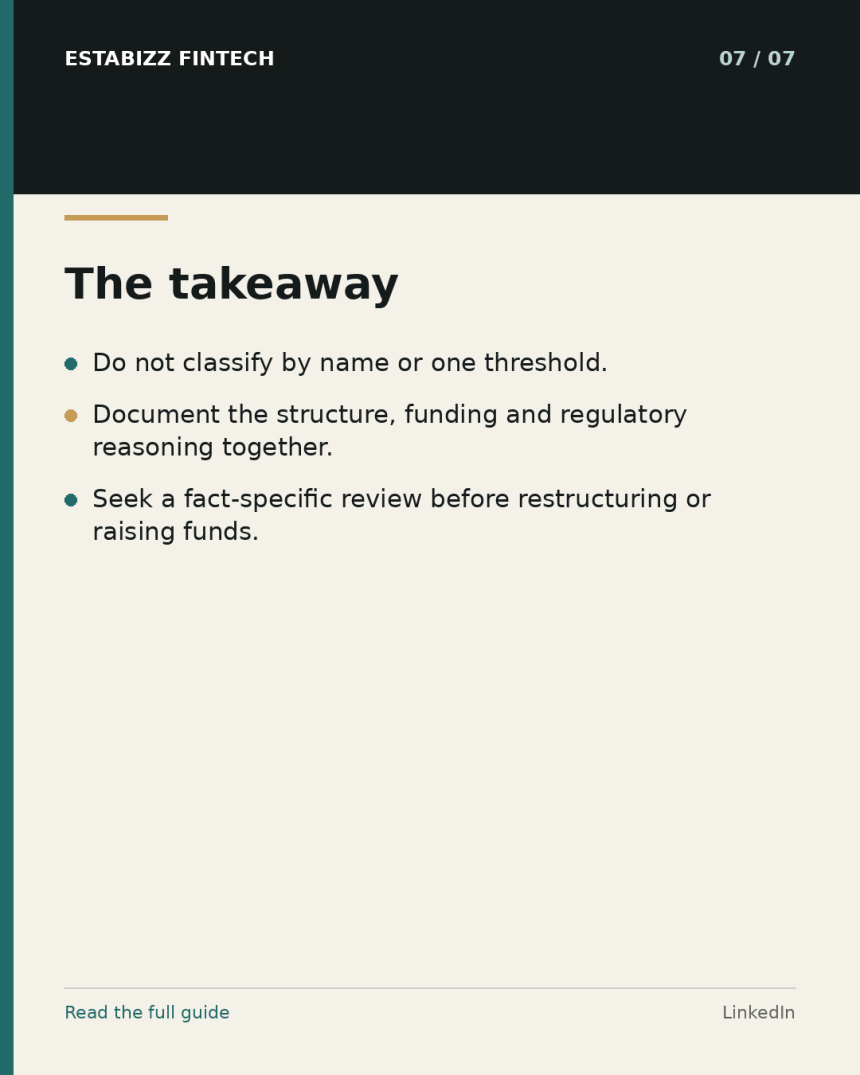
CIC registration is a classification-and-funding question, not a label. The safest analysis tests the 90/60 structure, permitted activities, asset size and public funds together, then documents how paragraph 17(3) affects the principal-business conclusion. Where the outcome depends on the unresolved timing debate, seek a fact-specific professional opinion or RBI guidance before restructuring or raising funds.
Written by
Estabizz Compliance Team
Regulatory Advisory, Estabizz Fintech
The Estabizz Compliance Team comprises regulatory advisers with extensive experience across RBI, SEBI, IRDAI and IFSCA frameworks.
Need professional assistance? Contact the Estabizz Team at 9825600907.
Disclaimer
This article is for general informational purposes only and should not be treated as legal, regulatory, tax or financial advice. Readers should consult qualified professionals before taking any business or regulatory decision.
Planning an RBI Licence?
Guidance on NBFC and other RBI registrations: eligibility, net owned fund planning, business plan, director documentation and the application, end to end.
Get insights like this delivered to your inbox
Subscribe to receive breakdowns of circulars, regulatory deadlines, and compliance updates.


